Cookie Preferences
By clicking, you agree to store cookies on your device to enhance navigation, analyze usage, and support marketing.
Thank you! Your submission has been received!
Oops! Something went wrong while submitting the form.

.svg)

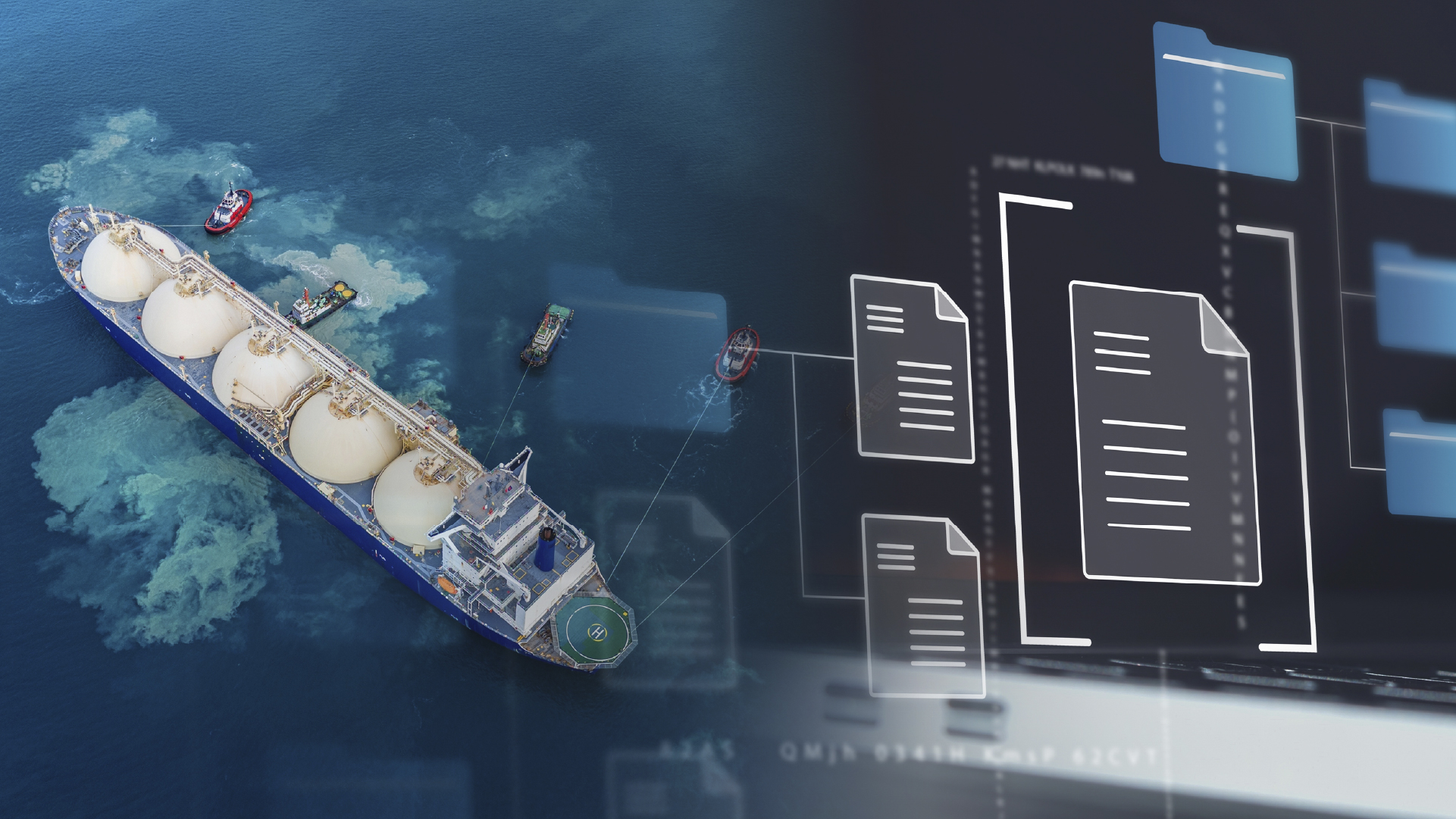
In today’s LNG sector, complexity is not a side effect of growth. It is the operating model.
Global LNG operations sit at the intersection of long-term contracts, joint ventures, volatile markets, strict regulatory oversight, and capital-intensive assets. Every commercial decision is bound by documentation. Every operational action is authorized, constrained, or governed by a document somewhere in the enterprise.
Many LNG operators have already invested heavily in automation to manage this complexity, particularly within finance and accounts payable. And yet, despite years of investment, a significant portion of work remains stubbornly manual.
This is not because automation failed. It is because automation was never designed to reason.
As LNG26 approaches, more operators are recognizing that document automation has reached a ceiling. The next phase is not incremental improvement. It is an architectural shift toward AI-powered document intelligence.
Across the energy sector, AP automation adoption has stabilized at around 60 percent. That figure tells an uncomfortable truth. Roughly 40 percent of invoice processing, validation, and exception handling remains manual, even in organizations that consider themselves highly automated.
In LNG environments, that remaining 40 percent is also the most expensive and risky work.
These are not clean, structured invoices. They are documents tied to:
• Complex rate structures
• Volume-based pricing
• Long-term supply agreements
• Joint venture cost allocations
• Cross-border tax and compliance requirements
• Service contracts with variable scope
Traditional automation systems can route invoices and extract fields. They cannot determine whether an invoice aligns with contractual obligations. They cannot interpret context across documents. They cannot explain why an exception exists.
As invoice volumes scale into hundreds of thousands, these limitations compound. Cycle times stretch from days into weeks. Vendor disputes increase. Financial visibility erodes. Treasury teams struggle to forecast cash requirements accurately.
This is not a workflow problem. It is an intelligence problem.
Every LNG enterprise is document-driven by design.
Contracts define pricing, volume commitments, and penalties. Joint venture agreements govern cost sharing and approvals. Shipping and chartering documents determine delivery terms. Maintenance records authorize work and validate spending. Regulatory filings and audit trails underpin compliance.
ERP systems record outcomes. Documents define intent.
When documents are treated as static records, decision-making becomes reactive. Human teams must constantly interpret, reconcile, and validate information that systems cannot understand.
This is manageable at small scale. It becomes unsustainable at LNG scale.
Intelligent Document Processing delivered meaningful progress. OCR digitized paper. Rules-based workflows automated routing. ERP integration enabled straight-through posting for simple cases.
But IDP systems were designed around consistency. LNG environments are defined by variance.
Traditional IDP cannot:
• Interpret contractual clauses across multiple agreements
• Reconcile invoices when data does not match exactly
• Handle unstructured documents without constant reconfiguration
• Adapt to new vendors, formats, or jurisdictions quickly
• Explain decisions in a way that satisfies audit and governance
As a result, the most complex documents are pushed back to humans. This is where delays, errors, and risk accumulate. Closing the automation gap requires systems that can reason, not just extract.
AI-powered document intelligence changes the role documents play in the enterprise.
Instead of treating documents as containers of data, AI systems interpret them as sources of knowledge. Large language models analyze language, structure, and meaning. Machine learning identifies patterns and anomalies. Reasoning layers apply business rules, policies, and constraints.
This enables capabilities that traditional automation cannot deliver:
• Validation of invoices against contracts even when terminology or structure differs
• Interpretation of unstructured documents such as field tickets and service descriptions
• Learning vendor-specific formats without templates
• Detection of anomalies before they propagate downstream
• Context-aware exception handling with clear justification
For LNG operators, this is not theoretical. It directly addresses the 40 percent of work that has resisted automation for years.
AI-powered document intelligence is most effective when delivered through an intelligent document hub.
An intelligent document hub connects invoices, contracts, approvals, and audit trails into a unified, governed environment. It does not replace ERP systems. It augments them by adding intelligence where ERPs lack context.
For LNG enterprises, this creates tangible operational benefits:
• Faster invoice processing with fewer manual touchpoints
• Reduced exception volumes through context-aware validation
• Continuous audit readiness with complete document lineage
• Real-time visibility into payables, obligations, and approvals
• Stronger vendor relationships driven by predictability and transparency
Documents stop being bottlenecks. They become decision-enders.
The next evolution builds on document intelligence with autonomous AI agents.
AI agents operate continuously, learn from outcomes, and act within defined governance frameworks. Unlike static workflows, they adapt to context.
In LNG environments, specialized agents can support document-driven processes end to end:
• Capture agents extract and validate data from any document format.
• Matching agents reconcile invoices against purchase orders, delivery records, and contracts.
• Exception agents investigate discrepancies, request missing information, and propose resolutions.
• Approval agents route decisions based on value, risk, and historical patterns.
• Communication agents handle vendor inquiries using real-time document context.
• Optimization agents forecast cash flow and time payments strategically.
These agents reduce manual workload dramatically while escalating only when human judgment is required.
This is not automation replacing people. It is intelligence removing friction.
LNG is a high-stakes, regulated environment. AI systems must be trusted.
Black-box decision-making is unacceptable where compliance, joint venture governance, and auditability are mandatory.
This is where Hybrid AI architectures matter. By combining large language models with symbolic reasoning, AI systems can:
• Apply explicit business rules and policies
• Produce transparent decision paths
• Generate auditable explanations
• Maintain consistent governance at scale
Every automated action can be traced. Every exception justified. Every decision reviewed. This allows LNG operators to deploy AI confidently without sacrificing control.
LNG enterprises do not need new systems. They need intelligence layered on top of existing ones. Modern document intelligence platforms integrate directly with ERP systems such as SAP, Oracle, and Microsoft Dynamics. Approved documents flow seamlessly into financial systems for posting and reporting.
AI operates above the system layer, enriching workflows without breaking established processes. This makes document intelligence a natural companion to ERP upgrades and cloud migrations, accelerating ROI rather than delaying it.
The discussions happening at LNG26 reflect an industry under pressure to do more with less.
More volume.
More complexity.
More scrutiny.
At the same time, margins are tightening and tolerance for operational inefficiency is shrinking.
The organizations that succeed will not be those that automate faster. They will be those that apply intelligence where automation stops. Document intelligence sits at the center of that shift.
The technology to close the automation gap exists today. The competitive advantage goes to LNG operators who move first.
AI-powered document intelligence delivers:
• Faster cycle times
• Lower risk
• Better cash flow control
• Stronger governance
Scalable operations without proportional headcount growth. It is not a back-office upgrade. It is an operational necessity.
LNG26 brings together the leaders shaping the next phase of global LNG operations.
If you are exploring how AI-powered document intelligence and autonomous agents can eliminate manual risk, strengthen governance, and improve financial agility, we invite you to meet with us.
Book a meeting with Beyond Limits at LNG26 - https://www.beyond.ai/events/beyond-limits-at-lng2026